Metropolitan Way of Life
The Asterion
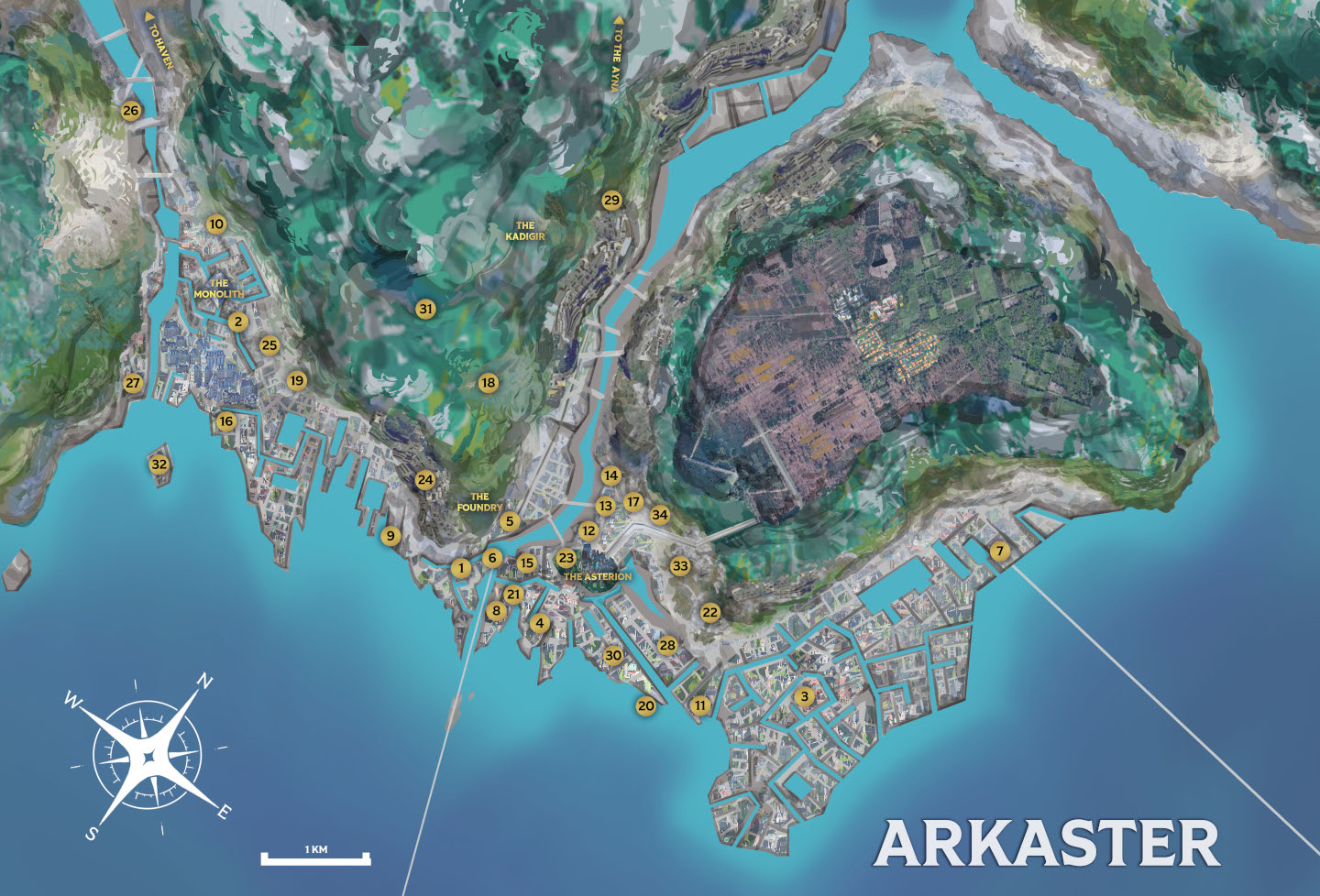
Located at the western tip of the Kuna peninsula, now surrounded by lacustrian districts built on stilts like the legendary city of Venice, the Asterion is the palace of the Basileus and the seat of Asgarthan power. Built on a rocky promontory and surrounded by splendid gardens, this alabaster citadel overlooks the bay and the opulent palazzi, displaying its unparalleled beauty for all to see. Some call it the "White Alhambra," referencing a relic of past times lost during the Confluence. Its architecture elegantly assimilates the influences of all the peoples who have come together in Arkaster, making it a symbol of the Concord. An incredible variety of styles and aesthetics blend and complement each other here, from oriental ornaments to the refined lines of the classical style. Its halls are very open, leading to graceful and sophisticated courtyards and interior gardens. It also houses numerous bodies of water that reflect the sky and vaulted columns, delicate sculptures, and climbing plants that adorn the walls. The Room of the Concord, where the representatives of the Factions and the Conclave sit, is a large circular hall where pulpits have been erected for each member, styled to reflect their position and affiliation. All are on the same level, including the Basileus's throne. It is topped by a glass dome, directly above a map of Asgartha engraved into the floor at the center of the circle. The map itself leaves space for all the territories yet to be discovered by the Expeditionary Corps.
Markets
In addition to its pop-up markets (the Akadori Market, on Suneplatz or on Calfuray Avenue, etc.) and local grocery stores (mainly the Cornucoopia chain), Arkaster has three main markets that open every day of the week:
Library
The Atrium (4)serves as the terrestrial counterpart to the Ordis Sanctum. Established about fifty years ago with the rise of printing technologies, this secondary library allows Asgarthans to research and borrow a wide variety of works, whether they be the novels of Vissente Narses, the short story collections of Nauja Puga, the philosophical treatises of Aurica or Ascanios Fenn, or among many others, the political pamphlets of Victoria Sasko. However, the Atrium, in addition to housing a vast collection of literary references, is also a vibrant community space. It features tea lounges, tranquil gardens where poets, actors, and thinkers perform at any time of the day or night, creating a lively and engaging atmosphere.
Bars
The Bacchanalia District (5)stretches from Via Dionysia in the west to the Plaza Arundhani in the east, along the Adrijan ruun-Tighe Canal to the Pier of Sighs. This lively neighborhood, where laughter and brawls alike resonate, seems to never sleep, from the misty dawn to the deepest parts of the night. It hosts a plethora of taverns, inns, bars, pubs, cervecerías, and speakeasies, from the most convivial dives, like the Sköll & Skál, to the most exclusive establishments, like the Whistle & Horn... Next to them, you can also find bustling cabarets, such as the dreamlike Birdcage or the sultry Tempest. It is also home to the White Lotus, a gaming house where the elite of Asgarthan society and weekend gamblers gather and mingle.
Theaters
The Ruzzante (30)is a neighborhood in Felsenwel that constantly pulses with life. During the day, you can hear discreet music notes, voices practicing in intimate courtyards, or diatribes echoing in the solitude of an alley... But it’s in the evening that this restrained daytime fervor bursts into an apotheosis of noise and fury. From impromptu street performances to jugglers and acrobats, from soloists wandering from terrace to terrace to booming-voiced singers, all of the Ruzzante seems to throb with the same fever, the same clamor. Amidst this vibrant and feverish atmosphere, the brightest jewels are the four stages of the Ulfur Tiedeman Wharf: the Astoria and the Nightingale, two theaters that have been rivals since time immemorial; the Solaris Hall, specializing in ballets; and especially the Spark, the opera house where Alteration performances, among others, are held.
City Hall
Formerly a royal palace for the Kuningas et Kuningatar, the Elysium (8) was converted into a town hall when the seat of power was transferred to the Asterion in 130 AC. It has since then stood on Plaza Stellaria as a remnant of Asgartha’s monarchial past. This is where some of the Ordis administrators have taken residence, aiming to candidly address the questions of the Asgarthan people. They gather the populace’s issues, taking the time to inform those interested about political or social developments, ensuring that they are well-prepared to vote and participate in various referendums. Although it retains the splendor and gilding of its former function, the Elysium is now considered the House of the People, and its doors are wide open to anyone wishing to enter. Inside, one can find the old city Archives as well as the offices of numerous clerks.
Harbor Office
Located on the docks,the Sextant (9)refers both to the harbor master’s office that oversees all maritime traffic and to the management body for the warehouses and docks in the Porto Novo district. The port officers supervise the arrivals and departures of ships, issue navigation rights, organize the allocation of berthing spaces, and oversee the monitoring of channels. The Sextant permanently houses the 9th division of the Stata Mater, aiming to quickly extinguish fires that might break out in the warehouses and buildings of the port area, as well as on the ships in the bay. An intricate network of quays, basins, locks, and canals, the new port is also connected to the Arsenal and theDaedalus Aerodrometo facilitate the transit of goods by air.
Hospitals
Two hospitals serve the Arkasterine population:the Caduceus (10), located on the Terraferma, andthe Asklepian (11), which sits on the waters of the lagoon. The Caduceus, built into the side of a cliff, is a semi-troglodyte complex. It features large dormitories and bucolic convalescence wings far from the frenzy of the capital. At its northern end lies a morgue, marking the entrance to the majestic Asphodel Cemetery. Here, the dead are prepared by the Ferrymen and taken to their final resting places in the cliffs. The Asphodel is freely accessible and consists of a vast network of galleries, terraces, and promontories directly bordering the precipice. Numerous waterfalls and gardens give it a peaceful and enchanting appearance. On the other hand, the Asklepian is situated in a much more urban setting. Easily accessible, it caters to a much larger population than its terrestrial counterpart. Under the stewardship of Messias Nyquist, the hospice operates at full capacity, treating ailments from the most minor to the most severe. Surrounding the Asklepian is a second cemetery,the Ruug, submerged beneath the lagoon's waters. Tradition holds that sailors prefer to be buried in the Ruug rather than on the heights of the Nishaanfjord. When the Tumult blows, those exposed and who survive are sometimes afflicted with mutations. These changes manifest either through physical alterations or by affecting an individual's mind or personality. A group of Alterers known asthe Rati, unaffiliated with any Faction, operates within both hospitals and local Asgarthan branches. Like surgeons, they attempt to remove these mutations, carefully excising them or using memory grafts to restore the patients' physical and spiritual integrity.
Temples
Arkaster, and to a lesser extent the entirety of Asgartha, is dotted with a myriad of small temples, lararia, and altars where it is possible to invoke the Oneiroi. These tiny chapels, often nestled between houses or located at crossroads, feature discreet frescoes and, most importantly, effigies of the Oneiros to whom they are dedicated. It is here that the Asgarthans communicate with their Eidolons, and it is not uncommon to see them appear to assist or answer the questions of mortals.
Museums
The influence of the Lyra has led to the construction of numerous museums throughout Arkaster, starting withthe Gundisalvus (12), dedicated to pictorial arts, tothe Peregrin Museum (13), detailing the history of the Tumult Nomads, and continuing tothe Hagen Collection (14), which gathers manuscripts from many writers. Most of these museums line the Sforafjord, with exceptions likethe Alteration Gallery (33), focused on ancient Alterers, andthe Palace of Eidolons (34), offering insight into who they were before the Confluence and their accomplishments since the cataclysm. The rest of the capital is also brimming with small museum wonders:the Emir Garfagnini Pavilions (15), where numerous sculptures are displayed,Karuna's Musicarium (16), combined with its own concert hall, orthe Science Museum (17)and its Planetarium, proudly situated within Renkairi. All these sites serve as examples of Arkaster's cultural richness.
Education
Arkaster is filled with places of knowledge and learning. Numerous small schools dot every district of the capital, each capable of accommodating between ten to thirty children depending on population density. This education typically lasts until the age of 12, where students must choose between a practical-focused curriculum or a more academic path: on one hand, applying directly to their chosen Guild, or on the other, joining a University or specialized Academy. This choice primarily depends on the candidates' personalities and aptitudes. Some prefer hands-on work, while others feel more comfortable in a scholarly environment. Within Asgarthan society, there is no value judgment between these paths; all contribute to the common good. For example, two individuals interested in studying History may have entirely different trajectories yet end up in the same profession. One might join the Guild of Historians as a simple clerk and climb the ranks by observing the work of their future peers, while the other may delve into old tomes at the University, accumulating knowledge before joining the Guild at a higher level. The entire educational system revolves around the idea that an individual should find their desired place within society. This willingness means that each person can choose to change their path at any time if they feel the desire or need. That's why the University, Academies, and Guilds impose no age restrictions. The same principle applies to Alteration. All human beings have the ability to manifest their own imagination. A baker might use Alteration to control the flames of their oven and manage baking temperatures, while an architect might make final adjustments to their construction projects. It is the Factions that set their own integration and teaching policies: Yzmir are famously rigorous, requiring entry through a stringent competition; in contrast, Muna are very permissive. However, very few individuals reach the sufficient level needed to venture into the Tumult expanses.
Squares and gardens
Arkaster is a city of winding alleys and narrow lanes, connecting the main thoroughfares and avenues of the city. But the capital also boasts idyllic gardens, majestic parks, and sumptuous squares, some very confidential, and others simply monumental. Among all these sites, mention must be made ofthe Plaza Stellaria (21), which before the opening ofthe Kuningasplatz (22)to the public represented the main square of the city. Even if it is now much less fresuented, the plaza is still splendid: from Concord Arch, the monument celebrating the alliance between humans and Eidolons that stands at its center, to the ancient city walls that are still visible there, or the Belltower of the Elysium, with its Great Clock... many scenes of Arkaster's history played out here when the First City was not as extensive as it is now.Vasanti Park (23), shaped by Alteration, testifies to the whimsical spirit of its creator. The groves and bushes, as well as the way plants and flowers grow and bloom, have been greatly modified by the Alterer, causing them to take on improbable shapes and colors. After several centuries, many strollers still come to see the fiery magnolias bloom there, each bud releasing a soft melody when it finally begins to open. And there is no shortage of other points of interest in Arkaster: fromClover Court (24)toSundial Square (25), throughthe Pilgrim’s Promenade (26),the Tamrat Quadrant (27), ontothe Aroro Lighthouse (32), visiting the metropolis is a once-in-a-lifetime journey, so full it is of secrets.
The Kurung (28)
The Kurung complex houses within its walls theAdalci—the previous Ordis Bastion and building now also referred to as the Small Court of Justice—, the prison, as well as the barracks and forts for the Aegis sentinels. Entirely dedicated to maintaining peace, the Kurung primarily handles the prevention and regulation of minor infractions, while more serious judgments are managed by the Ordis Tribunal. Within its grounds, one can see many clerks going about their tasks, as well as soldiers training on its esplanades and courtyards. Their ranks include both seasoned veterans and new recruits awaiting deployment across the Asgarthan territory. Additionally, the Kurung also provides accommodations for potential refugees and an orphanage. These social services mostly manage the influx of people displaced from their homes by the Tumult winds. However, for simplicity, many Asgarthans reduce the Kurung to its prison, especially when parents are admonishing their children.
The Guilds
Arkaster boasts numerous Guilds, many of which are affiliated with a Faction but operate autonomously. For instance, the Blacksmithing Guild and the Wagoners’ Guild are closely linked to the Axiom, while the Guild of Historians aligns more with the Ordis. The Guild of Luthiers shares affinities with the Lyra, whereas the Guild of Cartographers naturally associates with the Bravos. Some Guilds, on the other hand, have chosen to remain entirely independent, such as the Weavers’ or the Fishermen’s Guild. Each Guild has its headquarters scattered throughout the city, though most are concentrated in the Gwyntewyn district, which has always historically been the artisan quarter. It is within these Guilds that one learns their craft, primarily through hands-on experience, supplemented by theoretical knowledge. The Axiom originated from the amalgamation of certain Guilds—primarily technical ones—that expressed a desire to unite and become a formal Faction in their own right.
Sports
The Colosseum (29)is the city's main sports complex. While there are certainly more discreet ringby or altrun fields scattered throughout the various districts, the scale of the Colosseum and its secondary arenas is unmatched. With a capacity of nearly 40,000 spectators, the main stadium is a grand edifice. Its tiered stands cascade from its heights, bustling with life during matches as the crowds utter their deafening roar. During a ringby match, the two teams battle on the field to advance the ball towards the opposing ring, while each team's Alterers, positioned around the arena, assist, counter, or attempt to block opposing attackers using Alteration. For those put off by such brutality, official altrun competitions regularly take place here. Spectators can then witness tracers racing to complete a course that changes and transmutes before them, spinning, defying gravity, altering their environment themselves to move as swiftly as possible...